
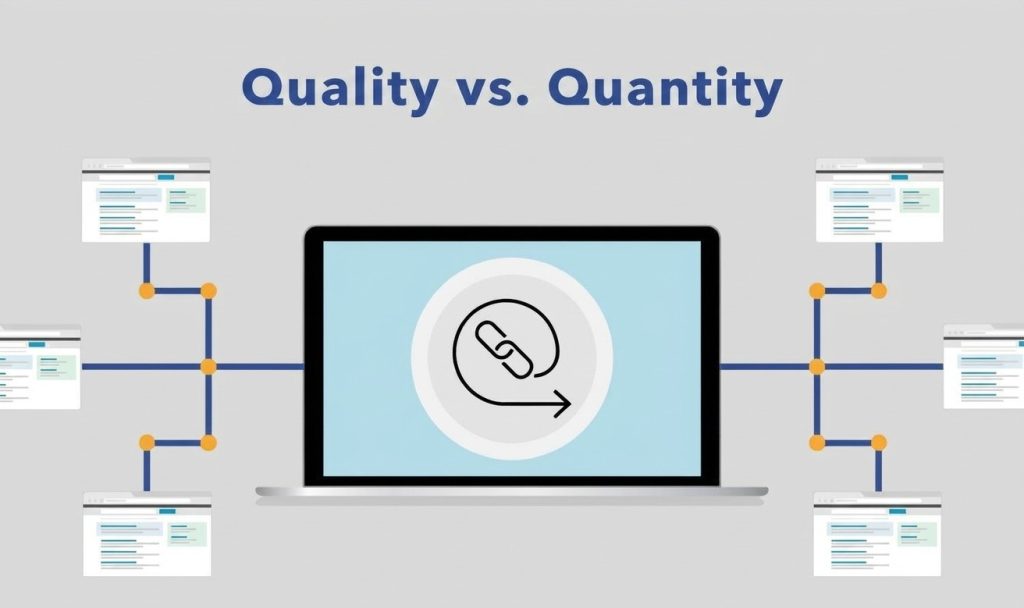
Backlinks remain an important part of SEO, but getting more links doesn’t necessarily lead to better results. A website can have hundreds or even thousands of backlinks and still struggle to improve its search visibility. This is because not all backlinks provide the same value.
A valuable backlink is more than just a link pointing to your website. Its value depends on factors such as the relevance of the linking website, the quality of its content, its organic visibility, and how naturally the link fits within the page.
Rather than focusing solely on backlink numbers, link building should prioritize relevant, trustworthy links that make sense within their content. Understanding these factors helps website owners make informed decisions and build a stronger backlink profile over time.
1. Why Backlink Quality Matters More Than Quantity
It’s easy to assume that having more backlinks automatically gives a website an advantage in search rankings. However, the number of backlinks alone doesn’t tell the whole story. What matters is whether those links come from relevant, legitimate websites and whether they provide genuine value.
The Problem With Chasing Backlink Numbers
Focusing only on backlink quantity can lead to poor link-building decisions. For example, acquiring dozens of links from unrelated websites, low-quality directories, or networks created primarily to manipulate rankings may increase a website’s backlink count without providing meaningful SEO value.
Instead of asking how many backlinks a website can acquire, it’s more useful to evaluate where those links come from and why they exist.
A link from a relevant website that naturally references your content can be more valuable than several links from unrelated pages with little editorial value. The goal should be to build connections that make sense for both the linking website and its audience.
Can Low-Quality Backlinks Hurt Your Website?
Not every low-quality backlink automatically results in a Google penalty. Google’s systems can identify and neutralize many forms of link spam. However, deliberately participating in link schemes to manipulate search rankings can violate Google’s spam policies and may result in ranking drops or a manual action.
Examples of link spam include buying links that pass ranking credit, excessive link exchanges, automated link creation, and paid guest posts that fail to qualify their links appropriately.
This doesn’t mean website owners should panic whenever they discover an unfamiliar or suspicious backlink. Google generally recommends that most websites do not need to use the disavow tool. The focus should be on avoiding manipulative link-building practices rather than trying to remove every link that looks questionable.
Why Link Building Takes Time
Link building is not an overnight process. Acquiring a backlink doesn’t guarantee an immediate improvement in rankings or organic traffic.
Search engines need to discover and process links, while the impact of those links depends on several factors, including the linking page, the destination page, competition, and the overall quality of the website.
This is why a sustainable link-building strategy requires consistency and careful evaluation. Rather than rushing to acquire as many links as possible, prioritize opportunities that are relevant, credible, and genuinely useful to readers.
2. Five Characteristics of a Valuable Backlink
Not all backlinks offer the same value. When evaluating a potential link opportunity, it’s important to look beyond basic metrics and consider the website, the linking page, and the context surrounding the link.
Here are five characteristics worth examining.
Topical Relevance
Relevance is one of the first things to consider when evaluating a backlink. A link from a website that covers topics related to your industry is generally a more natural fit than one from an unrelated website.
For example, a backlink pointing to a home improvement website from a property maintenance or interior design blog makes sense because the topics are closely related.
However, relevance doesn’t always mean that both websites must cover exactly the same subject. What matters is whether the linking page provides useful context for the destination website.
Website Trustworthiness
A website’s credibility matters when assessing a backlink opportunity. Look beyond its authority metrics and examine whether it appears to be a legitimate publication with a clear purpose and consistent content.
Check whether the website publishes useful articles, maintains a reasonable editorial standard, and serves an identifiable audience. Be cautious of websites that exist primarily to publish paid links or contain large amounts of unrelated, low-quality content.
A high authority score alone doesn’t guarantee that a website is trustworthy.
Organic Traffic and Search Visibility
Organic traffic can provide useful insight into a website’s visibility in search engines. A website that consistently attracts relevant organic visitors may offer a more meaningful link opportunity than one with inflated authority metrics but little search visibility.
Tools such as Ahrefs can help estimate a website’s organic traffic and identify the keywords bringing visitors to it.
However, traffic should not be treated as a standalone requirement. A newer, specialized website may still be relevant and valuable even if its estimated organic traffic is modest.
Contextual Link Placement
Where a backlink appears on a page can affect how useful it is to readers.
A link placed naturally within the main content, where it supports or expands on a topic, provides context for both readers and search engines. For example, linking to a relevant service guide while discussing a related subject gives readers a reason to visit the destination page.
By contrast, links placed in unrelated footers, sidebars, or sections with little editorial context may provide less value to readers.
The goal is to make the link a natural part of the content rather than inserting it simply to acquire a backlink.
Content Quality and Indexability
The quality of the linking page is just as important as the overall quality of the website. Review whether the article provides useful information, has sufficient substance, and is accessible to search engines.
Check whether the page is indexed in Google, whether it contains meaningful content, and whether it is relevant to the topic being discussed.
For link insertions, also consider the article’s age and existing outbound links. An established article with relevant content can be a good opportunity, provided the new link fits naturally and doesn’t compromise the page’s editorial quality.
Ultimately, a backlink should come from a useful page that offers genuine context for the linked website.
3. Why Domain Rating Alone Isn't Enough
Domain Rating (DR) is a metric developed by Ahrefs to estimate the strength of a website’s backlink profile. It is commonly used by SEO professionals to compare websites and assess potential link-building opportunities.
However, DR should never be the only factor when evaluating a website. A high DR score doesn’t automatically mean that a website is relevant, trustworthy, or capable of providing a valuable backlink.
Understanding the Limitations of DR
DR is based primarily on the quantity and quality of backlinks pointing to a website. While this makes it useful for comparing backlink profiles, it doesn’t directly measure content quality, topical relevance, or organic search performance.
For example, a website may have a DR of 70 but very little organic traffic. Another website with a DR of 35 may have consistent search visibility and publish content closely related to your client’s industry.
In this situation, choosing the website with the higher DR without further evaluation could mean overlooking a more relevant opportunity.
What Should You Check Beyond DR?
When assessing a potential backlink source, consider these additional factors:
- Organic Traffic: Does the website receive estimated traffic from relevant search queries?
- Referring Domains: Does it have a reasonably natural backlink profile, or does it show suspicious patterns?
- Topical Relevance: Does the website regularly publish content related to your client’s industry?
- Content Quality: Are its articles informative, useful, and maintained to a reasonable editorial standard?
- Indexability: Can search engines access and index the pages where backlinks will be placed?
Ultimately, DR is a useful reference point, not a guarantee of backlink value. A more reliable evaluation considers the website’s backlink profile, organic visibility, topical relevance, and the quality of the specific page where the link will appear.
4. Choosing the Right Link-Building Strategies
Not every link-building strategy works equally well for every website. The right approach depends on a website’s existing reputation, available resources, industry, and campaign goals.
In link building, strategies can generally be grouped into two approaches: link-producing tactics and association-producing tactics.
Link-Producing Tactics
Link-producing tactics focus on identifying specific opportunities where a website can earn a backlink through outreach or existing content.
Some common examples include:
- Email Outreach: Contacting relevant website owners or editors to introduce useful content and explore potential linking opportunities.
- Broken Link Building: Finding broken external links on relevant websites and suggesting suitable replacement resources.
- Resource Page Outreach: Identifying resource pages that link to useful industry guides, tools, or references and proposing relevant content for inclusion.
- Competitor Backlink Analysis: Reviewing competitors’ referring domains to identify potential websites that may also be relevant to your own campaign.
- Lost Link Reclamation: Identifying previously acquired backlinks that have disappeared and contacting website owners to understand whether they can be restored.
These approaches are useful when a campaign requires identifying and pursuing specific backlink opportunities. However, each prospect still needs to be evaluated for relevance, quality, and suitability.
Association-Producing Tactics
Association-producing tactics focus on building relationships, creating valuable resources, and earning recognition from other websites and publications.
Examples include:
- Digital PR: Developing newsworthy stories, research, or campaigns that attract attention from journalists and publications.
- Linkable Assets: Creating original research, useful tools, industry reports, or detailed guides that other websites may naturally reference.
- Guest Blogging: Contributing relevant, informative articles to established publications where the content provides value to their audience.
- Partnerships: Building relationships with relevant organizations, businesses, and industry partners that may lead to legitimate editorial mentions and links.
These strategies can help strengthen a brand’s presence within its industry while creating opportunities to earn relevant backlinks.
Choosing a Strategy That Fits Your Goals
The best link-building strategy isn’t necessarily the one that produces the most links. It is the one that aligns with the website’s goals, resources, and audience.
For example, a website with useful existing content may benefit from targeted outreach and resource page opportunities. A business with original research or industry expertise may have stronger opportunities through digital PR and linkable assets.
Regardless of the approach, the priority should remain the same: pursue relevant opportunities that provide genuine value rather than focusing solely on backlink acquisition.
5. DoFollow vs. NoFollow: Does Link Type Matter?
When evaluating backlinks, link attributes are another factor worth understanding. You may often encounter the terms DoFollow and NoFollow, which describe how links are qualified in a webpage’s HTML.
What Is a DoFollow Link?
A DoFollow link is the common industry term for a standard hyperlink that doesn’t include a rel attribute such as nofollow, sponsored, or ugc.
These links can be considered by search engines when evaluating a page’s links and ranking signals. However, having a DoFollow backlink doesn’t guarantee improved rankings. Its potential value still depends on factors such as relevance, the linking page’s quality, and the overall context of the link.
What Is a NoFollow Link?
A NoFollow link uses the rel=”nofollow” attribute to indicate that the website owner does not want to imply a traditional endorsement of the linked page.
Google originally introduced this attribute to help identify links that should not be treated as ordinary editorial endorsements. However, since 2019, Google has treated nofollow as a hint rather than an absolute directive when determining which links to consider for crawling, indexing, and ranking.
A NoFollow link may still provide value even if it doesn’t pass ranking signals in the same way as a standard link. For example, it can bring referral traffic, introduce a brand to a relevant audience, and create opportunities for further exposure.
What About Sponsored and UGC Links?
Google also provides specific link attributes for other types of links:
- rel=”sponsored”: Used for advertisements, sponsorships, and other paid placements.
- rel=”ugc”: Used for links within user-generated content, such as forum posts and comments.
- rel=”nofollow”: Can be used when a website wants to reference a page without implying endorsement.
Using the appropriate attribute helps search engines understand the nature of a link. For paid placements, sponsored is the preferred attribute, although nofollow is also acceptable.
Should You Prioritize DoFollow Links?
DoFollow links are often prioritized in link-building campaigns because they can be considered as ranking signals. However, focusing exclusively on link type can lead to missed opportunities.
A relevant NoFollow link from an established publication may still attract qualified visitors and increase brand exposure. Meanwhile, a DoFollow link from an unrelated or low-quality website may offer little practical value.
There is also no universal DoFollow-to-NoFollow ratio that every website needs to maintain. Instead of trying to achieve a specific percentage, evaluate each backlink based on its relevance, quality, placement, and potential value to the audience.
Ultimately, link attributes matter, but they should not be the only basis for deciding whether a backlink is worth pursuing.
Conclusion
Building a strong backlink profile isn’t about collecting as many links as possible. It’s about identifying opportunities that make sense for your website, your industry, and your audience.
As discussed, a valuable backlink involves more than a website’s Domain Rating or the number of links pointing to it. Topical relevance, website credibility, organic visibility, content quality, link placement, and link attributes all provide useful context when evaluating an opportunity.
The same principle applies to link-building strategies. Whether you’re pursuing guest posts, link insertions, digital PR, or other outreach opportunities, each prospect should be assessed based on its potential value rather than its ability to increase backlink numbers.
In the long run, a thoughtful approach to link building helps create a more relevant and sustainable backlink profile. Focus on the value each link brings, not simply how many links you can acquire.